Sunday, March 11, 2012

Chalk by Bill Thomson


Chalk by Bill Thomson

Thomson, B. (2010). Chalk. Marshall Cavendish
Modern Fantasy; Graphic Novel
          Chalk is a graphic novel, a story told without any words to read. Once I opened the book to start reading, I was fixed on figuring out the story by the use of the illustrations. I came up with the following story:
       One rainy day, Jasmine, Sarah, and Chris decided to walk home through the school playground. While walking they came across a bag hanging from the mouth of the dinosaur sling rider. Chris picked up the bag and they all looked inside. Inside this mysterious bag were pieces of chalk. Jasmine took the yellow piece of chalk and drew a sun on the blacktop of the playground. But this was no ordinary chalk, for as soon as she finished drawing a sun, the sun rose from the picture up into the sky, clearing up the rain and pushing the clouds away. Sarah got excited, so she took the next piece of chalk and drew butterflies all over the ground. Before she could finish drawing the last butterfly, the air was filled with them fluttering all around Chris and Jasmine. The kids were so excited to have discovered such amazing chalk! It was not Chris’s turn. He removed a green piece of chalk and drew a dinosaur. And to no surprise, there stood a dinosaur right in front of them! They were so scared they ran from the dinosaur, into the jungle gym to escape its big jaws. They all huddled inside the tunnel of the jungle gym. They didn’t know what to do, the dinosaur was after them. Suddenly Chris had an idea. He drew a cloud with rain droplets coming from it. It begin to rain, washing the dinosaur away. All that was left was a puddle of green from the wet chalk, where the dinosaur once stood. Jasmine and Sarah piled the chalk back into the bag, and Chris placed it back in the mouth of the dinosaur sling rider. They walked away, continuing home, leaving the bag of magical chalk for the next kid. The End.
This book teaches children to explore their imaginations. Not only must you imagine what the book is about from the pictures, but also the book tells an imaginative story about magical chalk drawings coming to life. Students can explore this book by writing their own story to go along with the pictures, or creating their very own graphic novel for someone else to create a storyline.

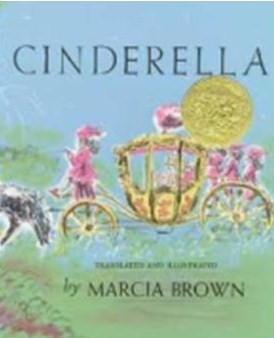
Cinderella by Marcia Brown


Cinderella by Marcia Brown

Brown, M. (1954). Cinderella. New York, NY: Atheneum Books for Young Readers
Traditional/Folk Literature; The Caldecott Medal
This book tells the French version of the magical story of Cinderella. Many young girls love the story of Cinderella, being familiar with the Disney version. When I hear this story, I think of when certain groups of people were oppressed by other groups. For example, African Americans were oppressed by White Americans and the people of India were oppressed by Great Britain. In this story, Cinderella was oppressed by her evil stepmother and stepsisters. She was treated like a servant instead of a loving family member, and never allowed to enjoy the finer things. However, in the end she was seen for her true beauty and attributes that were always hidden by her evil family members. This would be a great aspect to hit in the classroom, especially with the sense of certain groups formed within the classroom and school. What I mean by groups is the cheerleaders, the jocks, the nerds, and other stereotypical crowds students form in the classroom. This book could teach them that every person has a role to play in the classroom and they are all important. No group is inferior to the next.

Happy Birthday Martin Luther King by Jean Marzollo


Happy Birthday Martin Luther King by Jean Marzollo
Marzello, J. (1993). Happy Birthday Martin Luther King. New York, NY: Scholastic Inc.
Nonfiction Biography; Multicultural Literature
          Happy Birthday Martin Luther King depicts the reason why we celebrate Martin Luther King Jr. The reading style of the book is a bit repetitive, which is why I would suggest this for a younger reading level, lower elementary. An ideal time to read this book to the class would be around the day we celebrate this great hero, however, I would even consider reading it during a time when we learn about people and their differences. I’ve actually seen a lesson done in a preschool class where children pointed out what made them different from the next child, and embraced that difference. Whether it was skin color, hair, residence, or religion, they all knew what made them different. Then they talked about the many things they had common such as being human, going to the same school, and having the same teacher. This book could tie into this lesson, further stressing that fact that all people are different in some form or fashion, but we are all human and should be treated as such.

Gandhi by Demi


Gandhi by Demi

Demi (2001). Gandhi. New York, NY: Margaret K. McElderry Books.
Nonfiction Biography; International Literature
Topics: Gandhi, British control over India, Hinduism, weak student, he was shy afraid to speak in public,
“The force of love by peace always wins over violence”, was Gandhi’s motto. This book tells the great story of Mahatma Gandhi and his struggle to free India and its people from oppression, through love and peace, not hate and violence. A social studies lesson centered on the British’s control of India and the Hindu religion, could serve as a starting point to this book. Once students learn all about the oppression endured by the people of India by the British, and about India’s culture, they can then read this book to get an idea of how Gandhi helped put an end to the circumstances. The most interesting parts of this book are not about the history of India and Great Britain, yet about Gandhi’s personal growth. It mentioned that Gandhi was a weak student, failed many courses, and was very shy and afraid to speak in public. However, Gandhi went on to lead a country in a non-violent rebellion against their oppressors, successfully finish law school, and speak to crowds of millions. He overcame his personal struggles to become one the world’s greatest leaders of all times. Children could read or listen to this story and see hope in their futures. Those students, who are struggle in school with their grades, can now feel as if it is not over and that they can succeed if they try. Those students who are shy and afraid to speak up in class will now have the courage to say something, knowing that Gandhi could do so. This books not only serves as a great addition to a social studies lesson, but it also serves as a lesson on personal growth for all ages. 

Kai’s Journey to Gold Mountain: An Angel Island Story by Katrina Saltonstall Currier


Kai’s Journey to Gold Mountain: An Angel Island Story by Katrina Saltonstall Currier
 Currier, K.S. (2005). Kai’s Journey to Gold Mountain: An Angel Island Story. Tiburon, CA: University of Washington Press.
Historical Fiction; Multicultural/International Literature
This book is based on a the true story of Albert “Kai” Wong’s journey to America. At the age of twelve, Kai made the bravest trip any child could make, to be with his father. Kai travelled to America from China with no relatives, just other passengers all hoping to have the same results. He faced many challenges during his voyage, such as poor food and an interrogation; however, he handled each circumstance considerable. He kept in mind what his grandmother and father told him, “be a good boy” and “don’t cause any trouble”. In the end, he was able to reunite with his father in the “Gold Mountain”. Kai’s Journey to Gold Mountain: An Angel Island Story has many aspects to it that could be brought to the attention of the reader. White Americans were referred to as “white devils” by the Chinese. It would be interesting to see how students would react to this phrase, and see how others can have alternative perspectives of different parts of the world. This book would be ideal to connect to a social studies lesson about immigration that has the students exploring the Chinese Exclusion Act of 1882. This act was passed to keep the Chinese from coming into the United States unless they were merchants, scholars, or sons or daughters of current American residents. Students could talk about the many hardships Chinese immigrants faced in order to be in America with family members and start a new life.

The Tortoise and the Hare by Janet Stevens


The Tortoise and the Hare by Janet Stevens


Stevens, J. (1984). The Tortoise and the Hare. New York, NY: Holiday House
Folk Literature
The Tortoise and the Hare is a fable about a slow tortoise winning a race against a fast hare. The hare always teased the tortoise about being so slow at things, being rude and cruel. The tortoise was afraid to accept the hare’s challenge to race against him, but he did and he trained for the event. During the race the hare just knew he would win, so he stopped several times to drink, eat and sleep, allow the tortoise to catch up and ultimately win the race. The moral of the story is that “hard work and perseverance bring reward”. The tortoise never gave up, he worked hard to win the race, and his reward was the great win. This book teaches children that no matter how hard something may seem, if they work hard and persevere, they can succeed. The success is the reward in the end. This story would be great to read to the class during a time when students are facing a hard time in school. When the class feels defeated by grades, or when the EOG’s are coming up. Telling them to work hard at passing those EOG’s, with the help of this book, they will see the reward of their score in the end. 
 
Toondoo.com